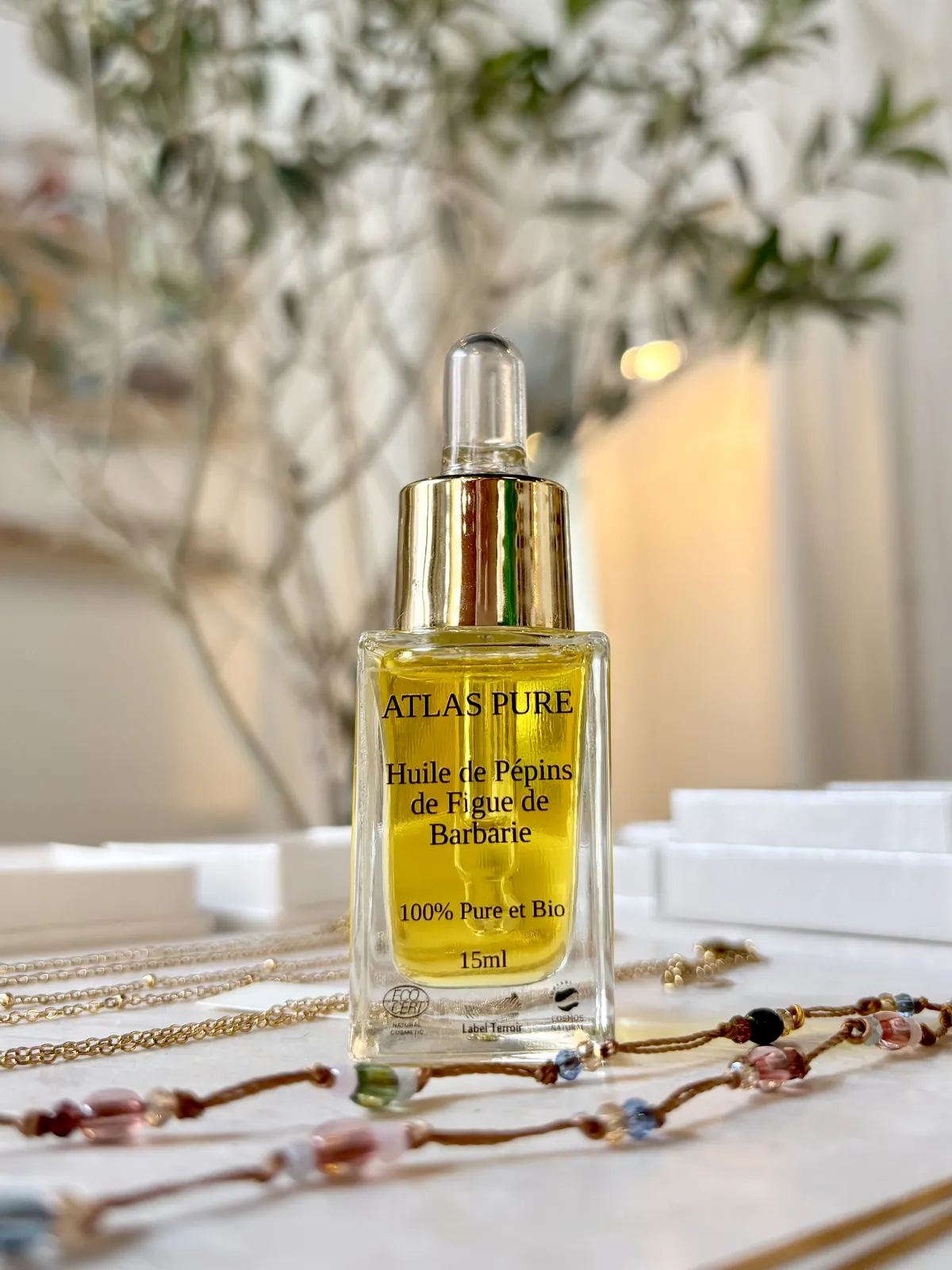
Rare and expensive, prickly pear seed oil can be blended with other oils or sold under misleading names. Here are a few pointers to help you identify pure prickly pear seed oil and make an informed choice.
The key difference: cold-pressed oil or macerate
This is the first distinction to make. Virgin cold-pressed oil is obtained by mechanically pressing prickly pear seeds, without heating or chemical solvents. It is a low-yield process, because the seeds contain only a small amount of oil.
A macerate (or "infused oil") is made by steeping plant material in a base oil, often sunflower oil, for several weeks. It is a legitimate product, but it is not pure prickly pear seed oil: its composition is mostly that of the base oil. If the label says "macerate" or "oil extract", you are not buying pure seed oil.
Color: golden yellow to greenish
Cold-pressed prickly pear seed oil is usually golden yellow to greenish in color. The shade can vary depending on where the fruit comes from and the process used.
An unusual color (bright orange, or almost colorless oil) may point to a refined, blended or mislabeled product: don't hesitate to ask the seller for details. A refined or deodorized oil has lost some of its original components.
Aroma: subtle, slightly green, never perfumed
Prickly pear seed oil has a discreet, slightly green aroma with a herbaceous note. You shouldn't smell a strong odor or any added fragrance.
If the oil has a strong fruity or floral scent, fragrance has probably been added. A pure oil keeps a discreet, natural scent.
Price: a clue, not proof
Producing cold-pressed prickly pear seed oil takes a lot of fruit and a lot of work, which explains its high price. Be wary of prices that are unusually low for the volume sold.
A very low price isn't proof of fraud, but it is a good reason to check the ingredient list, origin and certifications before buying.
Certifications That Matter
Certifications to look for:
Organic (Ecocert or another accredited body): the oil comes from organic farming, audited by an independent body. COSMOS: international standard for organic and natural cosmetics. Fair for Life: fair trade certification (fair price, decent working conditions). ISO 22716: good manufacturing practice for cosmetics.
No certification doesn't mean an oil is adulterated, but a certification audited by an independent body offers an extra guarantee.
Common pitfalls
"Prickly pear macerated in jojoba oil": this is a macerate, not pure prickly pear seed oil.
"Prickly pear extract": this vague term can mean many things. A pure oil appears in the ingredient list under the INCI name "Opuntia Ficus-Indica Seed Oil".
"Prickly pear fragrance": this is a scent note, unrelated to the seed oil.
Clear plastic bottles: rich in polyunsaturated fatty acids, the oil is sensitive to light and oxidation. Choose an opaque or tinted glass bottle, stored away from heat.
What the label must show
In the European Union, a cosmetic label must include, among other things (Regulation (EC) No 1223/2009, Article 19):
The ingredient list (for a pure oil: "Opuntia Ficus-Indica Seed Oil" alone). The name and address of the responsible person. The nominal content. A date of minimum durability or the period after opening (open jar symbol). The batch number. Any precautions for use. The country of origin for products made outside the EU. The origin of the fruit and certifications are useful extra information.
Be wary of labels that don't state how the oil was obtained, that blend the oil with other ingredients without saying so clearly, or that show no ingredient list.
Where to buy with confidence
Buy from producers or brands that are transparent about where their oil comes from. In particular, check for:
Traceability: the seller should be able to tell you where the oil comes from and which cooperative or farm produced it. Verifiable certifications. Transparency about how it is produced. Clear return conditions.
Discover our pure oil
Atlas Pure: 100% pure oil, cold-pressed from prickly pear seeds by a Moroccan women's cooperative holding Ecocert organic, Cosmos and Fair for Life certifications.
Discover our productsSources: Regulation (EC) No 1223/2009 on cosmetic products, Article 19 (EUR-Lex); Al-Naqeb G. et al. (2021), "Prickly Pear Seed Oil Extraction, Chemical Characterization and Potential Health Benefits", Molecules 26(16), 5018; COSMOS-standard (cosmos-standard.org); Fair for Life (fairforlife.org).