In the world of beauty oils, each oil has its own personality and strengths. How does prickly pear compare with other renowned oils? Here is a comparison that aims to be as fair and factual as possible.
Vitamin E: a naturally rich oil
Vitamin E (tocopherols) is a natural antioxidant found in many plant oils. Prickly pear seed oil is naturally rich in it, mainly in the form of gamma-tocopherol.
Levels vary depending on where the fruit comes from and how the oil is extracted, but published analyses place it in the same range as argan oil. Other oils, such as wheat germ oil, contain more.
Moroccan argan oil: the historic competitor
Argan oil is Morocco's best-known precious oil. It is extracted from the kernels of the argan tree, a tree endemic to Morocco (and western Algeria). Richer in oleic acid (omega-9, around 45%) than in linoleic acid (around 30%), it is well suited to dry skin and hair.
The two oils complement each other: argan, richer in omega-9, is more nourishing; prickly pear, dominated by linoleic acid (omega-6), is lighter. Rarer, it is also considerably more expensive.
Rosehip oil: rich in omega-3
Rosehip oil (extracted from the seeds of the wild rose) is rich in polyunsaturated fatty acids, notably linoleic acid and alpha-linolenic acid (omega-3). It is widely used in care for dry and mature skin.
Its high omega-3 content makes it more prone to oxidation, so it keeps for less time once opened. Rosehip and prickly pear can complement each other in a routine.
Jojoba oil: a liquid wax similar to sebum
Jojoba oil is actually a liquid wax, made up almost entirely of wax esters, a family of lipids also found in human sebum. Light and stable, it suits combination to oily skin well.
Prickly pear also offers a light texture, but with a different composition: it is an oil (not a wax) rich in linoleic acid and vitamin E. Jojoba, long used in cosmetics, remains a classic choice for combination skin.
Marula oil: rich in oleic acid
Marula oil is extracted from the kernels of the marula tree (Sclerocarya birrea), native to southern Africa. It is dominated by oleic acid (around 70% of its fatty acids).
Its texture is richer than prickly pear's. It suits dry skin that enjoys a more nourishing feel.
Price: a reflection of rarity
Prices for these oils vary widely depending on quality, certification, size and where you buy them. Because of its low yield, prickly pear sits at the top end of the range.
Always compare the price per milliliter, and check the ingredient list (INCI): pure prickly pear seed oil is listed as "Opuntia Ficus-Indica Seed Oil".
Rarity and Exclusivity
Prickly pear seed oil is rare: nearly a tonne of fruit for about one liter of oil, according to our producer. Its production is therefore on an entirely different scale from that of the major plant oils.
It is mostly found at brands specializing in natural cosmetics, and more rarely in supermarkets.
The verdict: every oil has its place
There is no "perfect" oil for everyone. The right choice depends on your skin type, what you're looking for and your budget.
Looking for a light oil rich in omega-6 and vitamin E, and happy to pay more for a rare oil? Prickly pear. An oil rich in omega-3? Rosehip. Combination to oily skin? Jojoba. A more nourishing feel? Argan or marula. Every oil has its strengths.
Discover our pure oil
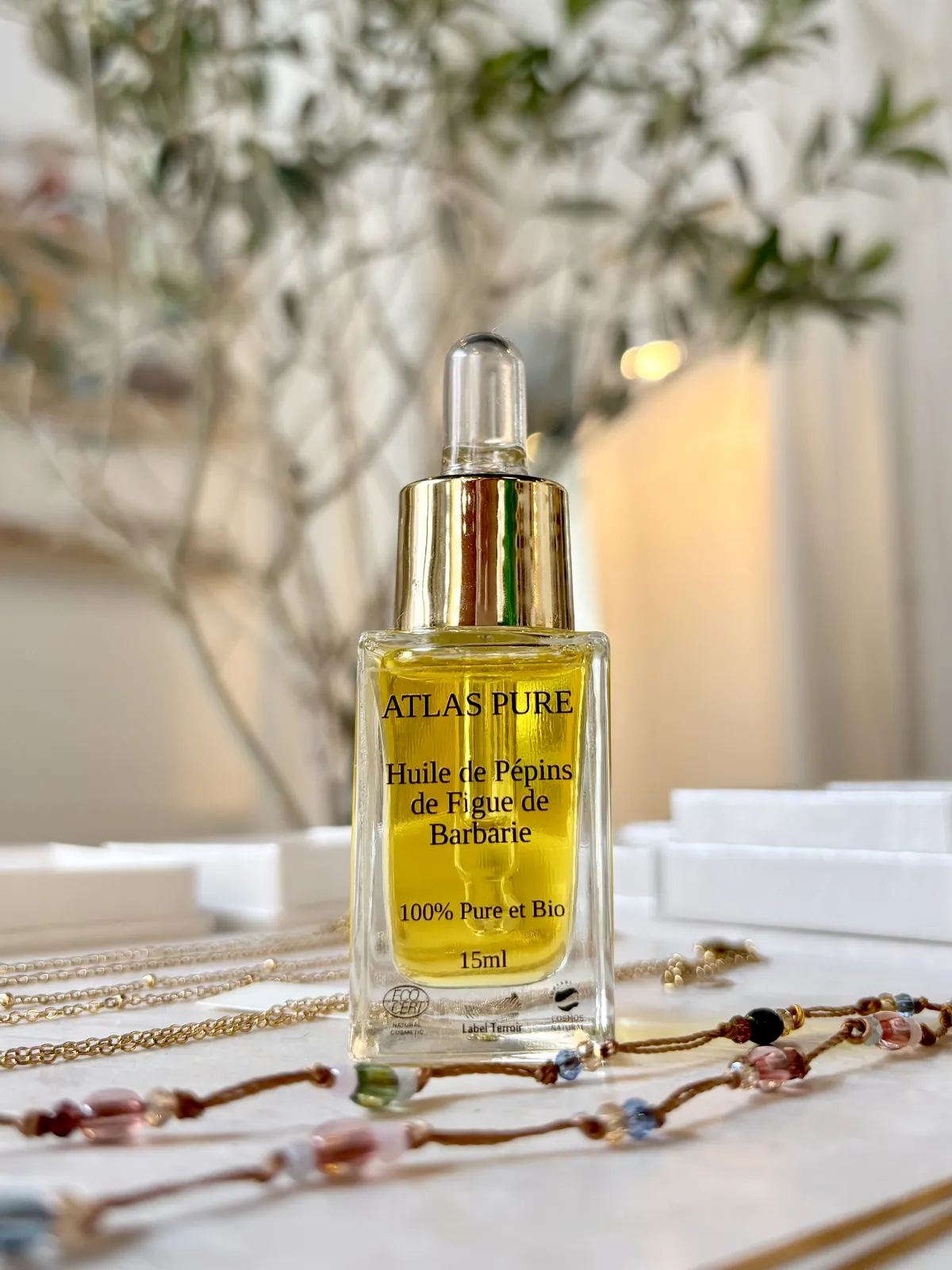
Atlas Pure: 100% pure oil, cold-pressed from prickly pear seeds by a Moroccan women's cooperative holding Ecocert organic, Cosmos and Fair for Life certifications.
Discover our productsSources: Ramadan M. F. & Mörsel J.-T. (2003), Food Chemistry 82(3), 339-345; Aksoz E. et al. (2020), "Vitamin E (α-, β+γ- and δ-tocopherol) levels in plant oils", Flavour and Fragrance Journal 35(5); "Chemical characterization of oils produced by some native and introduced genotypes of argan tree in eastern Morocco", OCL (2022); "Chemical Profile and Potential Applications of Sclerocarya birrea subsp. caffra Kernel Oils", Molecules/PMC (2024); GIE Targanine (targanine.com).