As climate change weakens conventional farming systems, a modest plant is proving valuable for economic and ecological resilience. The prickly pear makes productive use of arid land, sustains rural communities and opens a path toward more sustainable, fairer agriculture.
A plant that needs little water
Thanks to its distinctive photosynthetic metabolism (CAM), the prickly pear produces far more biomass per liter of water than conventional crops such as wheat or corn. It is perfectly adapted to drought and thrives where few other crops survive.
Its roots, shallow but widespread, quickly capture even the lightest rain, while its thick cuticle limits water loss. With water stress rising in North Africa, it is a crop with a future.
Fighting erosion and soil degradation
Soil degradation threatens a great deal of farmland in North Africa. Planted as hedges or in strips, the prickly pear helps stabilize the soil and limit erosion.
In Morocco, the planted area tripled between 1998 and 2017, largely in response to drought, before being hit from 2014 onward by an invasive cochineal, which now means replanting with resistant varieties.
Women's cooperatives: economic and social independence
In Morocco, particularly in the Souss region where GIE Targanine is based, prickly pear seed oil contributes to the economic independence of rural women. Women's cooperatives organize the harvesting, extraction and sale of the oil, generating income for women and their families.
Beyond income, these cooperatives strengthen women's place in their communities. Targanine says it invests in education, childcare and access to healthcare.
Fair trade and organic certifications
Organic certifications (Ecocert, COSMOS) attest to production without synthetic pesticides or chemical fertilizers. The Fair for Life fair trade certification, for its part, covers a fair price for producers, a development fund and decent working conditions.
These certifications open the door to demanding international markets and help cooperatives earn more from their production by selling to consumers who care where their purchases come from.
A sector with a future
Prickly pear seed oil is attracting growing interest in natural cosmetics. It is rare (nearly a tonne of fruit for about one liter of oil, according to Targanine), precious, and comes from supply chains that support rural communities.
For producing regions, it is an additional source of income that adds value to fruit grown on land where few other crops thrive.
Climate Change Adaptation and Food Security
Climate change is weakening food systems: extreme temperatures, prolonged droughts, irregular rainfall. Tolerant of heat and water scarcity, the prickly pear offers a kind of insurance against these risks.
The FAO itself presents cacti, including the prickly pear, as crops suited to a hotter, drier world: they can provide food, fodder and income even in difficult conditions.
Discover our pure oil
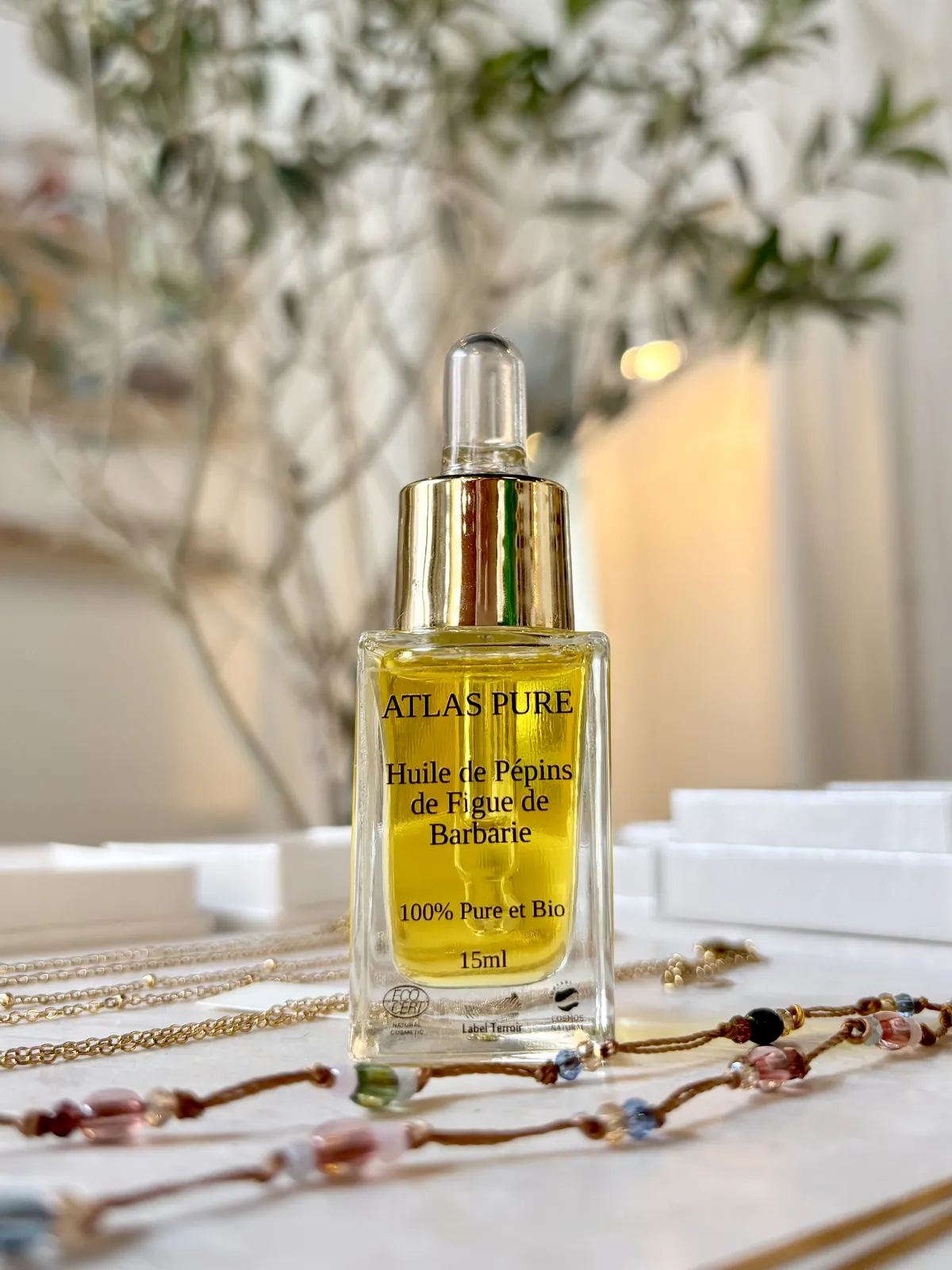
Atlas Pure: 100% pure oil, cold-pressed from prickly pear seeds by a Moroccan women's cooperative holding Ecocert organic, Cosmos and Fair for Life certifications.
Discover our productsSources: FAO & ICARDA (2017), Crop ecology, cultivation and uses of cactus pear (ed. P. Inglese); Feedipedia, "Cactus as a fodder and beyond"; "Root distribution with changes in distance and depth of two-year-old cactus pears Opuntia ficus-indica and O. robusta plants", South African Journal of Botany (2006); Scientific Reports (2023), study on Dactylopius opuntiae in Morocco; GIE Targanine (targanine.com); Fair for Life (fairforlife.org).